Waldorf education
An education that protects childhood and prepares children for life
Waldorf education is more than a hundred years old and is found in over a thousand schools around the world. But you won't grasp it from theory: you'll grasp it by watching what the children do each day.
Learning by doing
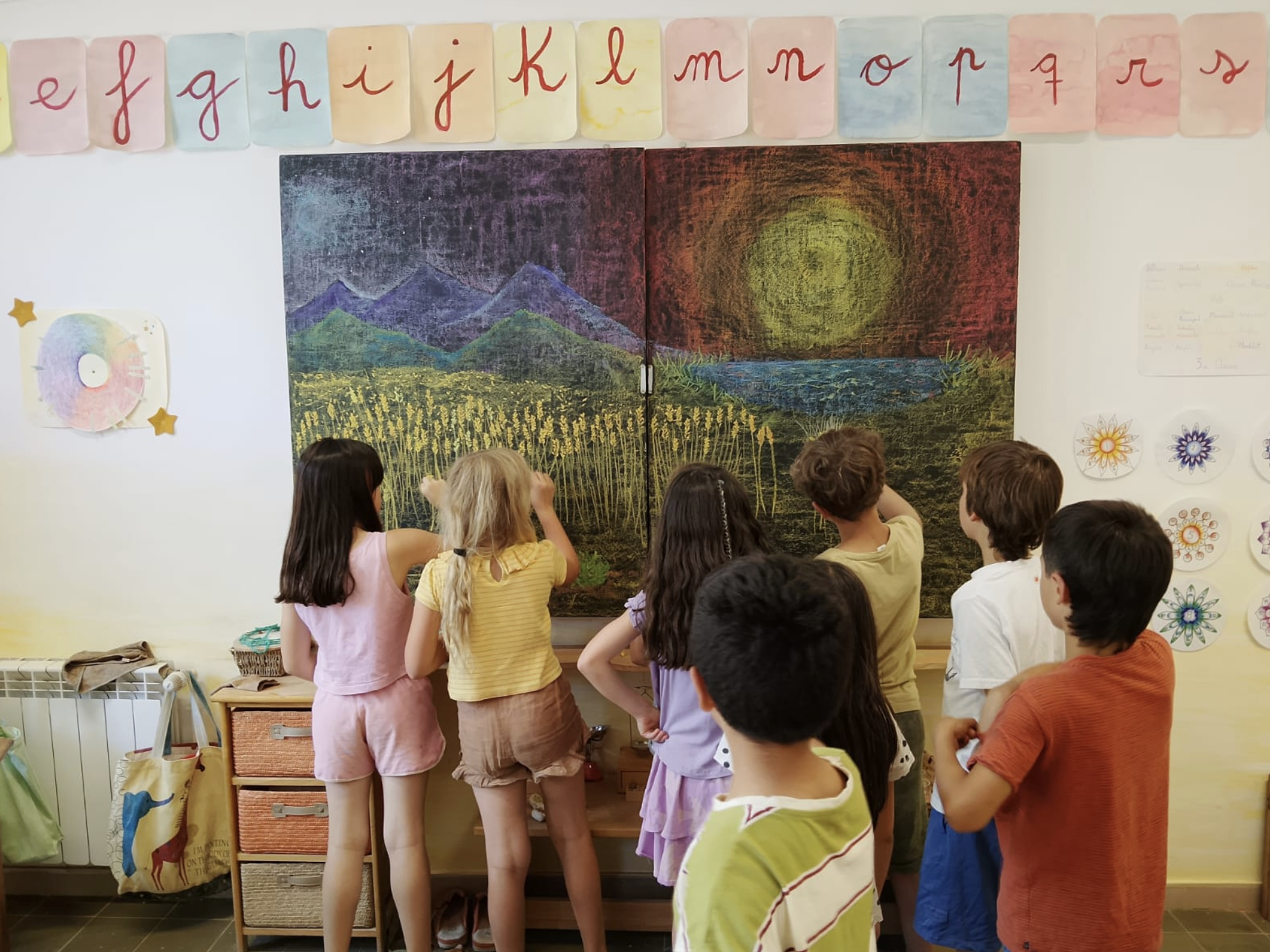
At La Font the children build, paint, weave, cook, thread, climb and observe nature. The body and the hands learn before the pencil does. Knowledge isn't explained in the abstract: it's lived, and that's why it takes root. Learning fractions by sharing out a loaf of bread, understanding geometry by drawing it, discovering history by telling it as a story.
Music and singing
At La Font we sing every day. From the earliest years the voice carries the rhythm of the day: songs for the seasons, simple melodies, and sung moments that move the children from one activity to the next. As they grow, singing turns to several voices and instruments join in, such as the recorder and the lyre, leading up to the choir and ensembles in secondary. Music is not a separate subject: it is a way of living together and learning to listen to one another.
Free of screens, by choice
We have no screens in the classrooms, and that's a decision, not a shortcoming. In the early years, the brain is built through movement, play and human connection. What a child needs to grow up healthy isn't more digital stimulation, but deep attention, time and real relationships.
We know that families live in a digital world and know it well. That's precisely why many choose us: they want their children to develop the capacities that are hardest to learn later, like concentration, imagination and self-regulation, before they come to technology. Everything in its own time.
And it isn't forever. In secondary school, at around 14, young people are introduced to technology on purpose: they learn to program and to understand how it works under the hood, not just how to use it. Roots first, then tools.
Everything in its own time
Waldorf education observes that childhood unfolds in stages of about seven years. Up to age 7, the child learns by doing and imitating, and needs play and rhythm. From 7 to 14, they learn through feeling, art and imagination. From 14 onwards, independent thinking and a critical view of the world awaken. Each stage asks for different things, and the curriculum adapts to them.
Why Waldorf, now
In a world that moves fast, that measures everything through exams and fills childhood with screens and competition, a slow, human and creative education isn't nostalgia: it's an answer. The children who know how to play, wait, cooperate and create are the ones who adapt best to a future we cannot predict.
In depth, not for the exam
Here we don't study to pass and forget. We learn to understand how things actually work: we observe before we explain, we look for the why behind each thing, and we connect what happened centuries ago with what we live today. When you understand the fundamentals, you don't have to memorise them: they're already yours, for life.
Ready for a world with artificial intelligence
The more a machine can do, the more valuable what only people can do becomes: thinking, creating, having judgement and understanding the world deeply. We don't protect children from technology, we help them build the roots to truly master it when the time comes.
And the learning itself?
Waldorf pupils move naturally on to secondary school, sixth form or university. Waldorf education is recognised by UNESCO, and our school is accredited by the Generalitat de Catalunya.
A little history
The first Waldorf school was founded in 1919 in Stuttgart by Rudolf Steiner, for the children of factory workers. Today there are more than a thousand Waldorf schools across the world, ten of them in Catalonia. La Font is one, rooted in Vic.
How to teach children can only come through a thorough, profound and loving understanding of the human being. This is what is meant to work and prevail in our Waldorf School.Rudolf Steiner — parents' evening, Stuttgart, 1921
Come and see it for yourself
No text can explain a school the way a visit can. We look forward to welcoming you.