6 – 12 years
Primary education
In primary school, first comes living, then understanding. Art and experience are the gateway to knowledge.
My experience at La Font school during primary and secondary school has been very positive, with excellent support. The way of learning and understanding the concepts has made them very clear to me to have a good foundation for high school.
At the heart of primary education is the development of the child in all their dimensions. Learning is offered in keeping with each stage of development, so that knowledge becomes meaningful, awakens curiosity and nourishes thinking as much as sensitivity and initiative. At this age, the child opens to the world above all through feeling; this is why we strive to make the experience of learning rich, full of beauty and meaning, so that they may discover that the world is a place worth coming to know.
The same teacher accompanies the group through the years, with continuous observation of each child. Art, music, movement and handwork aren't separate subjects: they're the way everything is learned. They all learn to play the recorder and to read music, and begin to sing in parts.
Joy and happiness in living, a love of all existence, a power and energy for work—such are among the lifelong results of a right cultivation of the feeling for beauty and for art.Rudolf Steiner — The Education of the Child
Main lesson taught in blocks
Each morning begins with the Main Lesson. We open the day with the Rhythmic Part, where movement, the spoken word and play wake us up and help us find a shared rhythm, preparing our attention, our body, our feeling and our thinking.
Then we move into the block, devoting ourselves to a single subject for three or four weeks. This time lets us live it, understand it and make it our own before letting it rest until we meet it again.
A class teacher who accompanies the years
The same class teacher accompanies the group throughout the stage, becoming a trusted adult and a loved authority. This bond fosters a deep knowledge of each child and a close, trusting relationship with families.
Art as a path to learning
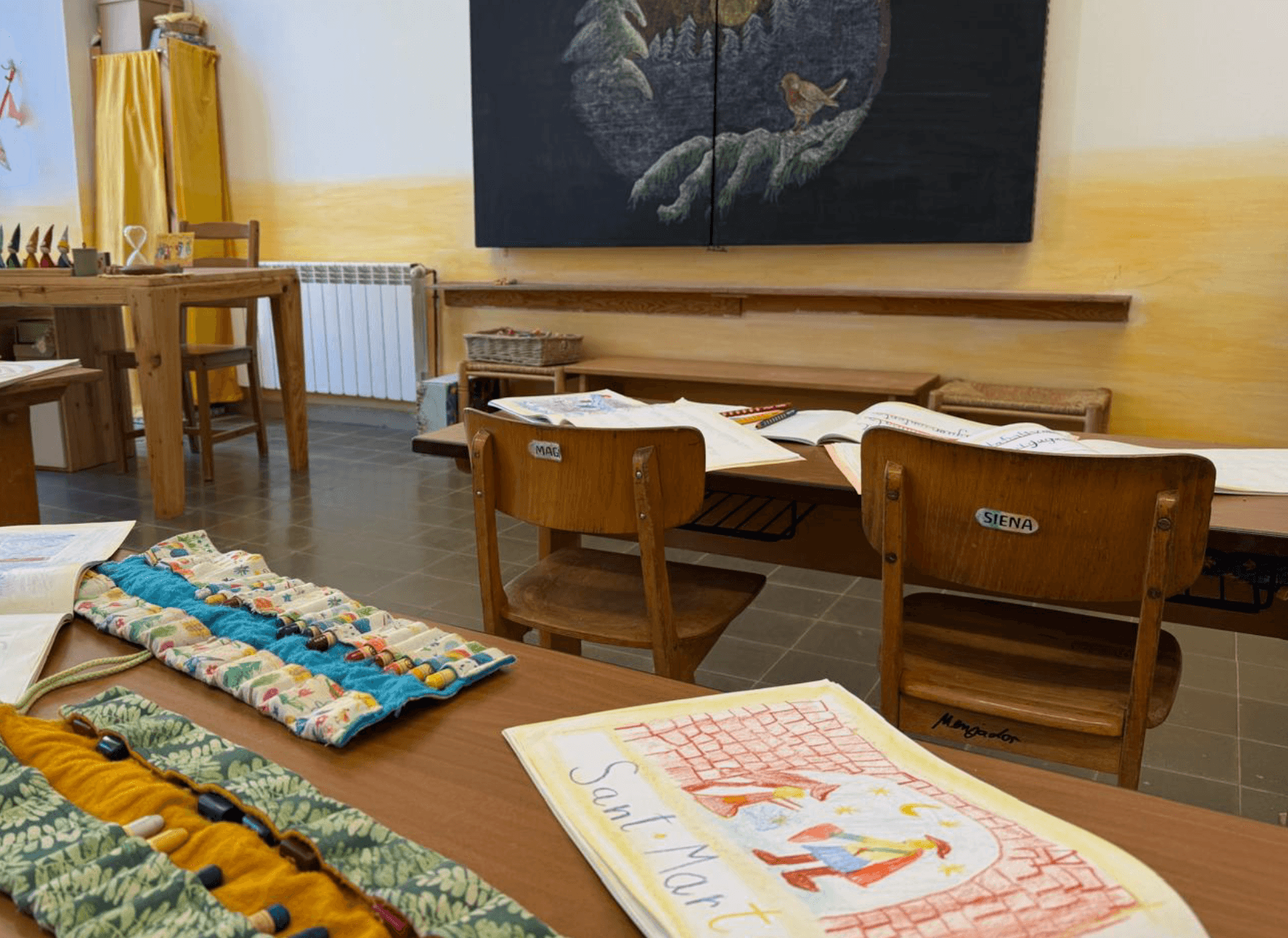
Drawing, watercolour, modelling (with beeswax, clay, wood and stone carving), music, dance, drama and handwork (crochet, knitting, sewing) are the vehicle for learning. Through artistic experience, children enter each subject, make the content their own and cultivate a sense of beauty, so important at this stage.
“Active hands, open heart, awake thinking.”
Continuous observation of the child
We choose attentive, continuous observation of each child by the team of teachers, so we can share it with families and build joint work between school and family that accompanies each child's growth.
The best way to understand it is to come and see
A Waldorf school is best understood by walking through it. We open our doors several times a year, and every month you can come on a guided visit. No commitment: just to get to know us.